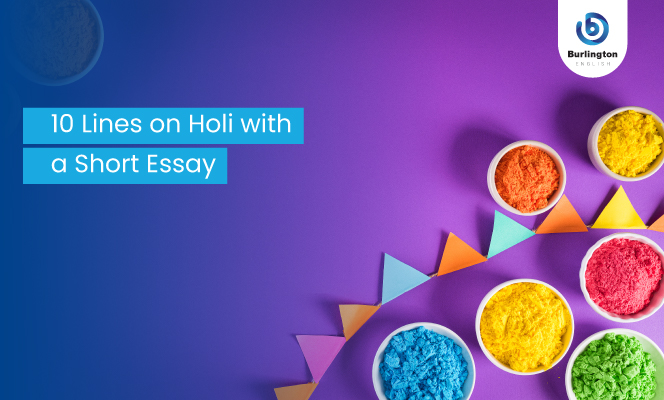

Imagine – a day when colours ride on the wind, where every individual looks like a vibrant canvas.
Well, Holi is such a day.
Holi is a festival in India where people from all different communities, ages, and social backgrounds celebrate the triumph of evil over good, by playing with colours.
Let us now explore how the festival of Holi came to be celebrated and its significance through 10 lines on Holi and a short essay.
10 Lines for Holi (For Grades 1 to 2)
- Holi is known as the Festival of Colours.
- We celebrate Holi because Lord Vishu defeated the demon king named Hiranyakashyap.
- We celebrate Holi by playing with colours.
- Children love to play with water balloons and water guns.
- We should use natural colours as artificial colours can be harmful.
- We can make natural colours at home by drying and grinding flower petals.
- Traditional sweets like gujiyas are made in every household.
- Neighbours share sweets with each other.
- Holi spreads happiness and joy.
- It gives us an opportunity to connect with our loved ones.
A Short Essay on Holi (For Grades 1 to 2)
Holi is known as the Festival of Colours. It is a festival that celebrates the victory of good over evil. It is said that Lord Vishnu defeated the demon king Hiranyakashyap on this day.
Everyone celebrates the festival by playing with colours. Children especially love playing with water guns and water balloons full of bright colours. It is important to be safe while playing Holi, as artificial colours can be harmful to the body. We can choose to make our own colours using ingredients at home (if you want to know how, simply read our blog: 5 Fun Holi Craft Activities for Pre-schoolers).
Traditional sweets and snacks are made in every household and shared with neighbours. Holi is a time of sharing happiness; and we should spend time with our loved ones during this festival.
10 Lines on Holi (For Grades 3 to 8)
- Holi is a major festival celebrated by people across India in the month of Phalgun, according to the Hindu calendar.
- People of all ages, regardless of their economic or social status, come together to celebrate by greeting each other with sweets, thandai (a flavoured milk-based drink), and gulal (coloured powder).
- Holi is played with coloured powder and water, which is why Holi is known as the festival of colours.
- Holi is celebrated to mark the triumph of good over evil.
- In Hindu mythology, Holi symbolises the victory of righteousness over wrongdoing, as seen in the tale of Lord Vishnu defeating a demon king named Hiranyakashyap.
- Legend has it that the demon king Hiranyakashyap was jealous of his son, Prahlad. The demon tried everything in his power to harm Prahlad. But Prahlad was a devotee of Lord Vishnu. Every time Prahlad encountered an obstacle; Lord Vishu came to his rescue, and Hiranyakashyap’s evil plans were unsuccessful.
- Holika Dahan takes place on the evening before Holi, where people light a bonfire with twigs and wood to symbolise the burning of Holika. According to legend, Holika attempted to burn Prahlad on a pyre under the orders of Hiranyakashyap but was consumed by the flames herself. People perform rituals around the bonfire on the night of Holika Dahan.
- The following day is known as Rangpanchami, Phagwa, or Rangwali Holi, when people celebrate by playing with coloured water and powders. Both adults and children fill pichkaris (water guns) and balloons with coloured water and have a blast.
- People greet each-other happily with sweets, thandai, and gulal. In some cities, large Holi gatherings take place, where people come together to celebrate with music and dance.
- Holi truly is a festival of unity, love, and togetherness.
A Short Essay on Holi (For Grades 3 to 8)
Holi, the Festival of Colours, is one of India’s most cherished and widely celebrated festivals. It marks the end of winter and the beginning of spring. It is observed in the Hindu month of Phalgun.
The festival has its roots in the mythological story of Prahlad and his father, the demon king Hiranyakashyap. Hiranyakashyap was an arrogant ruler who, after receiving a boon from Lord Brahma that no human, animal, or weapon could kill him either inside his palace or outside, believed himself to be invincible. In his pride, he demanded to be worshipped as a god. However, his son Prahlad remained devoted to Lord Vishnu, which enraged Hiranyakashyap.
After several unsuccessful attempts to kill Prahlad, Hiranyakashyap ordered his sister Holika to burn Prahlad alive. Holika had been given the boon of immunity from fire by the gods and accompanied Prahlad into the pyre with the intention of harming him. As the fire burned bright, Holika was astounded to feel the flames hurting her as Prahlad remained untouched. Lord Vishnu had once again saved Prahlad. Following this incident, Lord Vishnu appeared as Narasimha—half-human, half-lion—carried Hiranyakashipu to the threshold of his palace (neither inside nor outside) and defeated him with his claws. This legend symbolises the triumph of good over evil.
To commemorate this victory, the festival begins the evening before Holi with Holika Dahan. People build a bonfire using branches and twigs, sometimes placing an effigy of Holika on top. After sunset, people gather around, perform rituals, and light the tinder on fire to honour Lord Vishnu and express gratitude.
The next day is known as Rangwali Holi, Rangpanchami, or Phagwa. It is the main day of celebrations. People from all backgrounds come together with family, friends, and neighbours to enjoy the festival with boundless energy and joy. They greet each other with sweets, thandai (a flavoured milk-based drink), and gulal. Then the real fun begins—people splash each other with coloured water and powder, and dance to festive music.
Holi is a festival that reminds us of life’s simple pleasures. The explosion of colours brings joy, uplifts the spirit, and creates memories that last a lifetime. It is a day of togetherness, love, and harmony. As laughter fills the streets and vibrant hues paint the sky, we are reminded of the importance of unity and peace.
This year, let us make a resolution to celebrate Holi responsibly, using eco-friendly, organic colours, just as it was done traditionally. We can either choose to buy organic colours or can have fun by drying flower petals and making gulal out of them. To check out our craft ideas this Holi, you can check out our blog:
Happy Holi everyone!