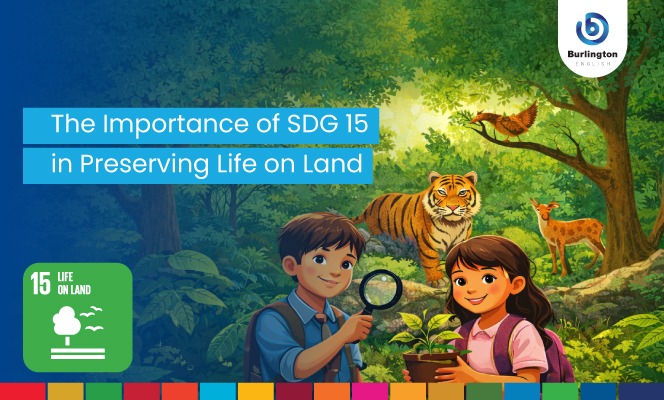

We often underestimate the wonder of life on the land we all inhabit. From the tiniest ant to the oldest banyan tree—every form of life maintains balance on planet Earth. The United Nations’ goal SDG 15: Life on Land asks us to pause and notice what is being lost due to human apathy—forests shrinking, species disappearing, soil degrading, and ecosystems breaking under human pressure.
Our ecological heritage offers us a powerful lens through which we can rethink our relationship with nature. It prompts us to reflect on how we severed our relationship with the very nature from which we all originated. In Indian tradition, we celebrate forests as living classrooms. In the hymns dedicated to Araṇyānī in the Rig Veda, the forest goddess is invoked and praised for her tendency to provide sweet fruits to visitors and for punishing traitors who harm the forest.
Through the hymn, we are reminded that the forests and the lands are nurturing as long as we respect them. Ancient gurukuls were in forests, symbolising that learning happens in the presence of nature, not away from it. This civilisational ethos continues with NEP 2020’s emphasis on experiential and environment-rooted education.
UN’s SDG 15 reinforces the same truth. When we lose biodiversity, we lose the foundations of life itself. Healthy soil ensures food security, forests regulate the climate, and diverse species maintain ecological stability. Schools and colleges play a crucial role in nurturing this awareness.
A walk in the school garden, observing local birds, maintaining an herb patch, or identifying native trees may look like small experiences, but they shape lifelong attitudes toward nature. When students understand how interconnected living systems are, they see the Earth not only as a resource but as a friend with whom they can build a relationship.
India is one of the megadiverse countries. Our landscapes—from the Himalayas to the Sundarbans, from the Western Ghats to the Thar Desert—carry wisdom about survival, co-existence, and balance. Stories from the Panchatantra and other IKS traditions can help younger learners see nature as both a curriculum and a teacher. Similarly, older students can be encouraged to link local ecological observations with global data, reports, and scientific studies, strengthening their capacity for inquiry and global citizenship.
Restoring degraded lands, ending deforestation, and protecting endangered species are the larger targets of SDG 15. But these goals can only be achieved when institutions and individuals work together. When a school reduces paper use, conserves water, creates biodiversity corners, or adopts a patch of land to restore, it contributes to the planet’s healing.
Schools must encourage students to observe local ecosystems. Student-led biodiversity mapping, composting units, seed bank creation, and greening projects nurture an understanding of both the fragility and resilience of life on land.
SDG 15, a values agenda, encourages us to introspect. We are forced to ask- “What kind of relationship do we want with the Earth—one of extraction or one of care?” Our scriptures, epics, and folklore have long affirmed that nature is not an external commodity; it is Prakriti, the ever-giving mother. NEP 2020 echoes this philosophy through its focus on environmental stewardship, life-skills education, and learning that leads to responsible citizenship.
In this sense, SDG 15 becomes a pedagogy of mindfulness. When students monitor the quality of the soil in their school garden, observe the changing colours of local trees, or study the migration of birds, they learn patience, humility, and curiosity. These are the qualities that prepare the students not only for examinations but for life.
A Call to Action for Schools and Educators
As schools across India strengthen their SDG-linked programmes, SDG 15 offers a concrete, achievable entry point. Every school—rural or urban, large or modest—has the potential to contribute meaningfully. The few steps suggested below can make a real difference toward achieving the goals of SDG 15:
* Creating a butterfly patch, a medicinal garden, a seed-saving corner
* Integrating biodiversity themes across subjects
* Linking classroom activities with global goals
* Engaging families and communities
* Celebrating annual Life on Land Week
These steps may look simple and familiar, but they can deepen a culture of responsibility.
Toward a Shared Ecological Future
If our classrooms can inspire even a fraction of the reverence towards Prakriti, SDG 15 will become a lived reality rooted in Indian wisdom, strengthened by modern science, and carried forward by the next generation of mindful global citizens.
Preserving life on land is not only an environmental mission; it is a moral, pedagogical, and civilisational commitment. The Earth, Dharini, sustains us, shelters us, nourishes us. Thoughtful educators and curious children must promise to care for the land that cares for us.
If you are interested in reading about SDG 13, you can read our blog – Climate Action: How SDG 13 Can Help Save Our Planet.
Happy reading!
By Ashok Pandey, SDG Advisor